The Primary Routine
Primary Montessori Curriculum
The Montessori Primary Curriculum serves the child from ages 2.5 through 6 years old!
 Practical Life
Practical Life encompasses essential activities and skills aimed at nurturing a child's independence and responsibility towards themselves and their surroundings. Within our classroom setting, we categorize these activities into two primary domains: Care of Self and Care of the Environment. While adults might perceive practical life tasks as simple "cleaning" activities, they hold profound significance in fostering a child's development of fine and gross motor skills, concentration, independence, and the ability to follow sequential steps. Moreover, engaging in these activities empowers the child to become an active participant in their community, thereby enhancing their sense of self-worth and confidence. It's worth noting that toddlers are naturally inclined to assist both at home and in the classroom, demonstrating their eagerness to contribute and learn.
 Language
In the Montessori classroom, language permeates every aspect of the environment, recognizing that toddlers are in a sensitive period for the development of communication. Thus, our classrooms prioritize creating a rich linguistic space where young learners are surrounded by opportunities for language acquisition and expression. Adults serve as models for oral language, guiding children in articulating essential needs and navigating social interactions effectively. Language materials and lessons are carefully curated to support the child's vocabulary development, employing tools such as nomenclature cards, realistic items, and image cards to enhance understanding and engagement. Reading is seamlessly integrated into the daily experiences of the child, fostering a love for literature and expanding their cognitive horizons. Furthermore, adults play a crucial role in modeling proper grammar, pronunciation, and appropriate expression, providing a foundation for effective communication and linguistic growth. By immersing toddlers in a language-rich environment and offering guidance through meaningful interactions, we cultivate confident and proficient communicators who are equipped for success in both social and academic realms.
 Mathematics
In a Primary Montessori environment, mathematics is introduced through hands-on materials that make abstract concepts tangible. Children explore counting, patterns, place value, and basic operations using tools like number rods, bead chains, and golden beads. This approach fosters deep understanding, independence, and a joy for problem-solving.
 Sensorial
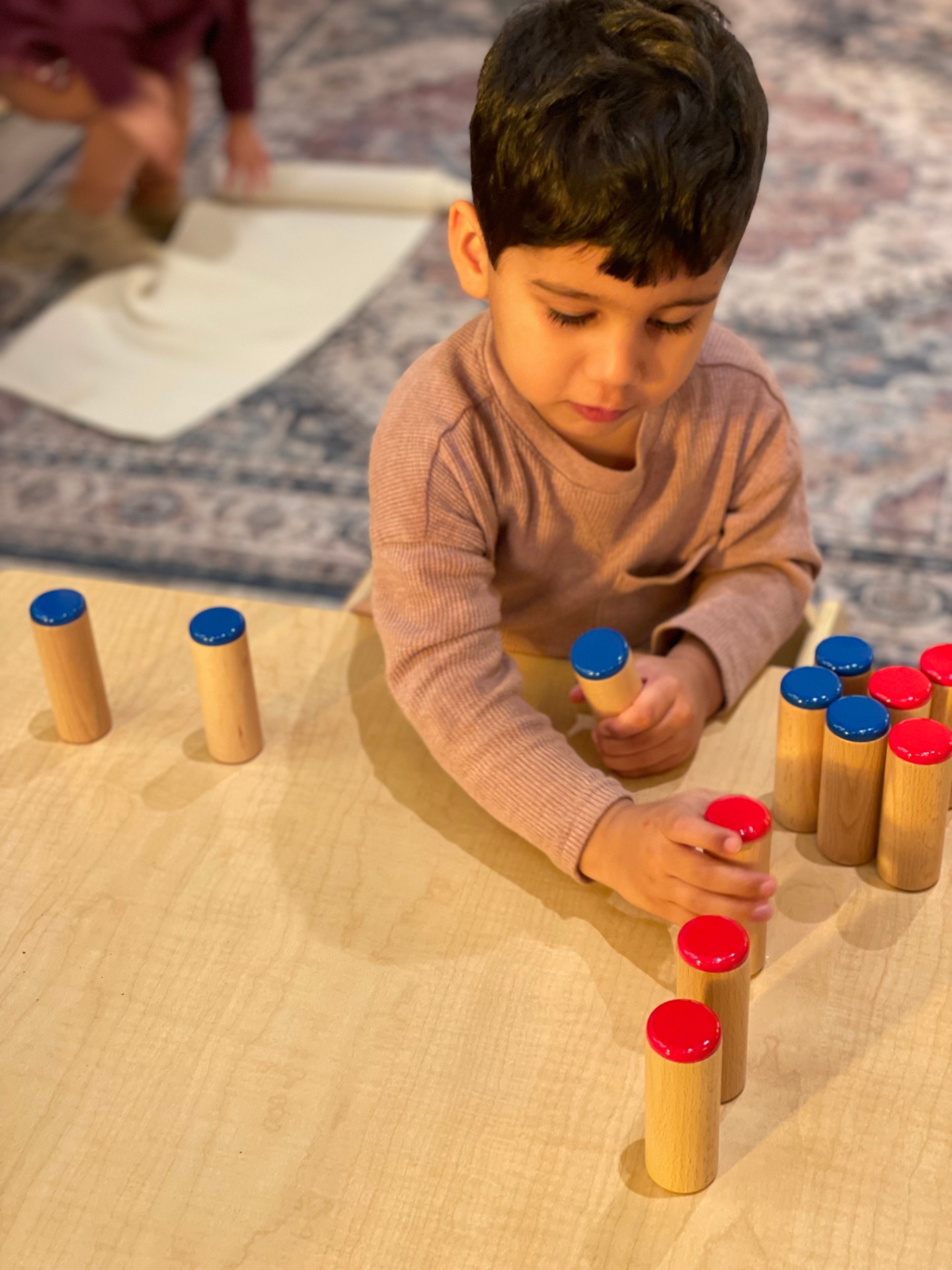
In the Primary Montessori classroom, sensorial materials help children refine their senses while supporting cognition and mental categorization. Using tools like color tablets, geometric solids, sound boxes, and texture boards, children explore and organize their experiences, develop precise language, and build foundational skills in geometry, geography, and other areas of learning. These hands-on lessons foster observation, concentration, and a deeper understanding of the world around them.
 Geography
In the Primary classroom, geography is taught through hands-on, sensory materials that help children understand the world around them. Using maps, globes, puzzle continents, and cultural objects, children explore landforms, countries, and communities. This approach builds spatial awareness, global understanding, and curiosity about diverse cultures and environments.
Children develop a sense of place by exploring from the whole to the individual. They begin with the globe, then study continents, countries, states, and finally their own town. This outward-in approach helps children understand their connection to the wider world before focusing on their immediate environment.
 Sciences
Texto de muestra. Haz click para seleccionar el elemento de Texto.
Primary Environment